Medical Device
Manufacturer

Chăm sóc vết thương·Hydrogel wound dressing

GANA PATCH

A bio-cellulose sheet carrying high-concentration cross-linked hyaluronic acid. Applied to an open wound it keeps the wound moist, absorbs exudate and protects against infection, and is changed once a week rather than every day.

01 Tổng quan

Hydrogel occlusive wound dressing — bio-cellulose sheet with cross-linked hyaluronic acid

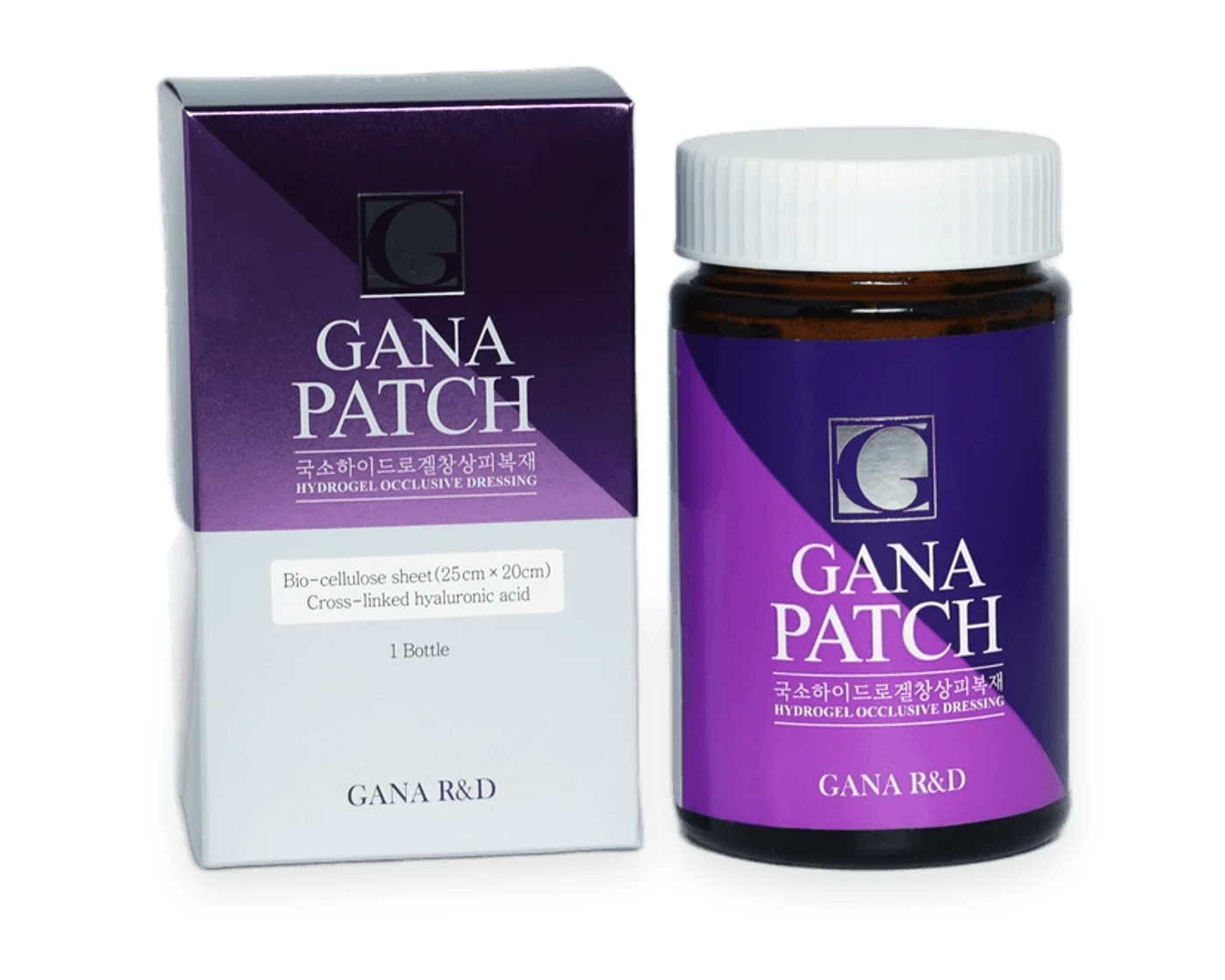
  • Quy cáchSheet supplied in a sealed bottle, 1 bottle per carton. Sheet sizes 15 × 10 cm and 25 × 20 cm.
  • Thành phần
    • Bio-cellulose (bacterial cellulose) sheet
    • Cross-linked hyaluronic acid, high concentration
  • Nhóm hoạt chấtHydrogel wound dressing
  • Đăng ký3 còn hiệu lực · Hàn Quốc · Nga
  • CatalogueCatalogue sản phẩm GANA R&D 2026, trang 94–96

Chi tiết sản phẩm được hiển thị bằng tiếng Anh theo catalogue của GANA R&D.

Yêu cầu thông tin sản phẩm
GANA PATCH — cartons and bottles in two sizes

02 Có hồ sơ chính thức

Đăng ký của sản phẩm này

GANA R&D được ghi là nhà sản xuất trên từng mục. Mọi số đăng ký đều có thể tra cứu trên hệ thống công khai của cơ quan quản lý.

Tên đăng kýKhu vực pháp lýĐăng kýĐược cấpPhạm viTra cứu
GANA PATCH Hàn Quốc · MFDS 제인20-4997 10 thg 11, 2020 Phê duyệt trong nước Hệ thống công khai→
GANA PATCH, hydrogel wound dressing Nga · Roszdravnadzor РЗН 2024/22431 18 thg 4, 2024 — Hệ thống công khai→
GANA PATCH foam (GANA DERM) Hàn Quốc · MFDS 제인15-4197 15 thg 10, 2015 Xuất khẩu Hệ thống công khai→

Hệ thống đăng ký của Roszdravnadzor dùng chứng chỉ do nhà nước Nga cấp. Trình duyệt ngoài nước Nga có thể hiển thị cảnh báo bảo mật trước khi mở hồ sơ.

Nhà sản xuất

  • Giấy phép sản xuất MFDSGANA R&D Co., Ltd. · MFDS No. 4490 · Hệ thống công khai→
  • Chứng nhận GMPKCL-ABBA-19926 · hiệu lực đến 3 thg 3, 2027
  • Cơ sở sản xuất555 Dunchon-daero, Jungwon-gu, Seongnam-si 13215, Republic of Korea

03 Từ catalogue

Chi tiết sản phẩm

Trích từ catalogue sản phẩm GANA R&D 2026. Dành cho nhân viên y tế; nội dung này không thay thế hướng dẫn sử dụng kèm theo sản phẩm.

What GANA PATCH is

GANA PATCH is a bio-cellulose sheet containing cross-linked hyaluronic acid. Its main use is the covering of open wounds. Bacterial cellulose is non-allergenic and does not cause inflammation in the body.

Development objective: a wound-covering material for patients with widespread skin damage, who until now have been very hard to treat.

What is different

  • As soon as it is applied, GANA PATCH keeps the wound moist by preventing evaporation
  • Prevents infection
  • Mechanical and chemical protection
  • Absorbs exudate
  • Reduces pain
  • Components of GANA PATCH stimulate collagen synthesis in the soft-tissue defect, so exudate stops
  • The high-concentration cross-linked hyaluronic acid gel absorbs watery content from the wound
  • Fills the soft-tissue defect immediately and keeps it moist
  • No need to change the dressing every day: change GANA PATCH every week
  • For major wounds with soft-tissue loss and epithelial damage, GANA PATCH includes active ingredients for epithelial-cell and soft-tissue regeneration

Course of healing

  • Skin graft not necessary: after immediate application, skin function recovers from burns or skin loss
  • Regeneration of soft tissue and epithelium: the bio-cellulose itself replaces soft tissue mechanically
  • No further wound dressing necessary: once applied, the wound is simply observed until it has healed
  • Progress: bio-cellulose causes no immune side effect or other response in the body; epithelial cells migrate onto GANA PATCH, which may then be positioned under the epidermis

The ideal wound dressing

  • Able to resist infection
  • Able to prevent water loss
  • Able to withstand shear forces
  • Cost-effective
  • Widely available
  • Long shelf life and easy to store
  • Lack of antigenicity
  • Flexible in thickness
  • Durable, with long-term wound stability
  • Conforms to irregular wound surfaces and is easy to secure and apply

Bacterial cellulose

Bacterial cellulose is an organic compound with the formula (C₆H₁₀O₅)n produced by certain bacteria, principally of the genera Acetobacter, Sarcina ventriculi and Agrobacterium. It differs from plant cellulose in its high purity, strength, mouldability and increased water-holding ability, and by controlling the synthesis it can be tailored to specific properties. Historically limited to nata de coco, it is now used in textiles, cosmetics, food products and medical applications.

SEM findings: the aperture of bacterial cellulose is so small that cells and bacteria cannot pass through it, only water, and its surface area is so wide that the bio-cellulose holds a large amount of water. In conclusion, bio-cellulose protects against infection, absorbs exudate from the wound and lets water evaporate outward.

Hyaluronic acid (hyaluronan) is an anionic, non-sulfated glycosaminoglycan distributed widely through connective, epithelial and neural tissues. It is unique among glycosaminoglycans in being non-sulfated, forms in the plasma membrane instead of the Golgi apparatus, and can be very large, with a molecular weight often in the millions. As one of the chief components of the extracellular matrix it contributes to cell proliferation and migration. The average 70 kg person has roughly 15 g of hyaluronan in the body, one third of which is turned over every day.


How to use

  1. Sterilise the wound
  2. Take the GANA PATCH sheet out of the bottle, using sterile technique
  3. Cover the wound with the GANA PATCH sheet
  4. Cover the sheet with sterile gauze
  5. Change GANA PATCH every week

The wound does not need to be cleaned every day; just check whether there is any sign of infection.

Chăm sóc vết thương→

Yêu cầu hồ sơ kỹ thuật.

Giấy chứng nhận đăng ký, hướng dẫn sử dụng và tài liệu kỹ thuật của sản phẩm này được cung cấp cho nhà phân phối và phòng khám theo yêu cầu.

Yêu cầu thông tin sản phẩm